Showing posts with label Panoramic Mirror. Show all posts

Wednesday, July 18, 2012

2-mirror combinations

We've got to that point in our research, where we can do our own thing and be creative, while having our goal in mind.  I guess it's worth mentioning our goal again.  We are trying to obtain an ultra wide field of view with minimum/no distortion. Awesome, so let's get to work by which, of course, I mean let's combine any two mirror that we have been introduced to you in the past couple of weeks.

(1): The first 2-mirror combination that we looked at was a combination of the rectifying with the panoramic mirror.  we know that the rectifying mirror has an outstanding record for imaging the floor with the minimal distortion that is all lines are mapped to lines. We also remember that the panoramic mirror otherwise known as the wall-mirror could be used for imaging the surrounding walls.  So, by combining these two mirrors we should be able to image the floor and the surrounding wall and achieve an ultra field of view.

In order to achieve the above combination of mirrors, we find the point of intersection between the graphs of panoramic and rectifying mirror (we showed how to obtain the graphs of these mirrors in the previous posts). We cut the panoramic mirror before the point of intersection, so that we only have the rectifying mirror at first.  Then, after the intersection point, the rectifying mirror is cut so that there is only panoramic mirror.  In this manner, as the object moves from the floor to the walls, we image a hemisphere.  However, the farther we get from the center to the walls, the greater the distortion and the results are not satisfactory.


(2): The second mirror combination that we experimented with is the rectifying mirror and a linear mirror.  The steps in this experiment identical to the first case.  However, in this case, the linear mirror only changes the path of light and has no impact on the field of view and is therefore unhelpful.


(3): The third case involved combining the rectifying mirror with good old parabolic mirror. Surely you have noticed that all three of these cases have a rectifying mirror in their combination and the underlying reason for choice of mirror is that we have seen through our calculations and experiments that the rectifying mirror provides a perfect image of the floor plane.  Therefore, in our combinations we are just looking for a second mirror that increases our field of view to approximately 180 degree with minimum distortion. We considered using parabolic mirror in this combination because of its focal properties.  If you remember, in a parabolic mirror the light rays will always pass through its focus point. However, the image is very distorted in this case! The equation of the parabolic mirror used here is:  


Panoramic Mirror with Infinity Trick

Not to sound lazy or anything but the numeric solution for the panoramic mirror in the last post was just too much work!  That is why we tried to solve it analytically, this time.
So, we still have the same panoramic mirror as before, where the object is positioned on a surrounding wall with the coordinates (k, ax+b). The image plane is below the x-axis and is indicated by y=-k.
But, here is the time to use a trick.  We know that "a" is an arbitrary scaling factor and the bigger the "a", the bigger the field of view.  Therefore, it shouldn't matter whether it is ax+b or kax+b or gax+b.  "a", "ka" and/ or "ga" are all scaling factors.  So, for the sake of our trick, let's say it is kax+b. 
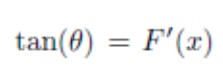
Now, once again, we draw the tangent line to the mirror at point (x, F(x)) and we have:

(1)
 (2)

Using the tangent double-angle formula we have:  
 (3)
Here is where the trick comes into the picture.  Suppose k is going to infinity and find the limit of tangent of 2theta:

 (4)
It looks so cool, doesn't it?
By equating the (2) and the (4) equations, we get:


YAY! We got our differential equation.  Now, by solving this differential equation in maple and finding the surface of revolution in Pov-ray we obtain the same results as we did previously :) 

Thursday, June 28, 2012

Panoramic Mirror


More mirrors!!! Awesomeness!!  This time we are back to mimic panoramic imaging. Panoramic imaging covers up to 360 degrees, this is while the approximated field of view of humans is 95 degrees out, 75 down, 60 in and 60 up!

As shown in the picture below, the  panoramic mirror is  surrounded by walls so far away from the optical axis of the mirror  that the walls seem like a cylinder.  This mirror reflects the image of an object positioned on the wall .  In all the previous cases that we studies, the object was positioned on the floor. However, regardless of the position of the object, out goal remains the same.  We want to find the equation of such mirror with orthographic projection.


As shown in the picture, we draw the tangent line to the mirror where the light ray hits the mirror,  By forming a triangle we show that
We know that tangent of an angle is opposite over adjacent.  Thus, we find the tangent of angle 2 theta as following:


Now, we can easily use double-angle identity,


By equating the two equations, we have a differential equation to solve in Maple based on x and a:

a is a scaling factor and the bigger the a, the bigger the field of view and less distortion.  
1) a=1
2) a=500
3) a=1000
However, we tried to further reduce the distortion in the mirror by increasing a beyond 100, but we didn't notice any significant change in the distortion pass that point.